Read the full story
Foundation brings unique insights on business, building product, driving growth, and accelerating your career — from CEOs, founders and insiders.
Promote the Intern
Organizations can't spend their way to victory.

When I graduated from college, I didn't know what I wanted to do with my career. In late 2006, after an unfulfilling year at a consulting firm, I tried joining an investment firm. It was the start of the financial crisis, things were getting interesting in financial markets, and I had no money to lose.
But I had no experience. No investment banking internships in college; never read a 10-K; no idea what made a good company or a bad one. After months of searching, I met my future boss, Robert. Robert ran the trading desk at Oak Hill Advisors, a hedge fund and asset manager in New York City.
Robert was looking for someone who had recently graduated from college to join the trading desk. This was how he had started his career at Salomon Brothers in the mid 1980s, and he followed a model that he had seen work. After an interview of math questions (no point asking me about investing because I knew nothing), he agreed to a one month internship.
My first assignment was building an Excel model of the fund's future financials with a scenario machine in Visual Basic. I got the job in early 2007. Less than a year after I joined the firm, Bear Stearns collapsed, and Oak Hill's trader was unreachable on vacation. I traded my first bond.
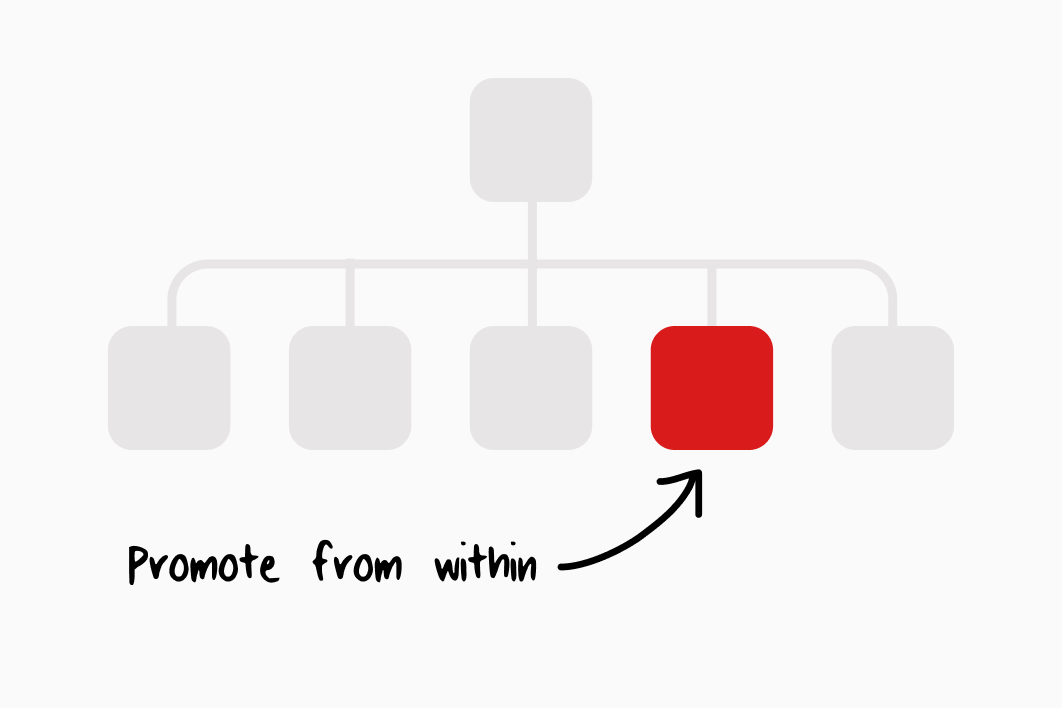
I had been promoted from within. This worked well for both sides: the firm was able to train me to do things the right way, and I was loyal to the firm, ultimately staying for many years.
We're hiring!
"We're hiring! " was stamped on LinkedIn profiles everywhere during ZIRP to signal a company's success.
When startups raise a lot of money, they usually try to hire a lot of people. Money goes in and output follows, the concept goes. But the idea that money can deliver a top performing team is wrong. Oak Hill understood this, developing talent from within.
If it were possible to buy a top team, many more companies would succeed. Great teams routinely achieve the improbable task of bringing a startup from infancy to scale; mediocre teams never do. But great teams are very rare. Because you can't build an all-star team solely by spending money, startup success is also very rare.
During the zero-interest-rate period of excessive, cheap capital, investors and companies ignored generations of team building lessons. Companies measured success by organization size, leading to bloat. Worse, quantity in hiring is inversely correlated with quality. The only way to scale a top performing organization is by developing and training talent from within.
At Albert, the banking app I run, we try to follow what I first saw work at 23 years old. My career started as an intern.
Albert's leadership team
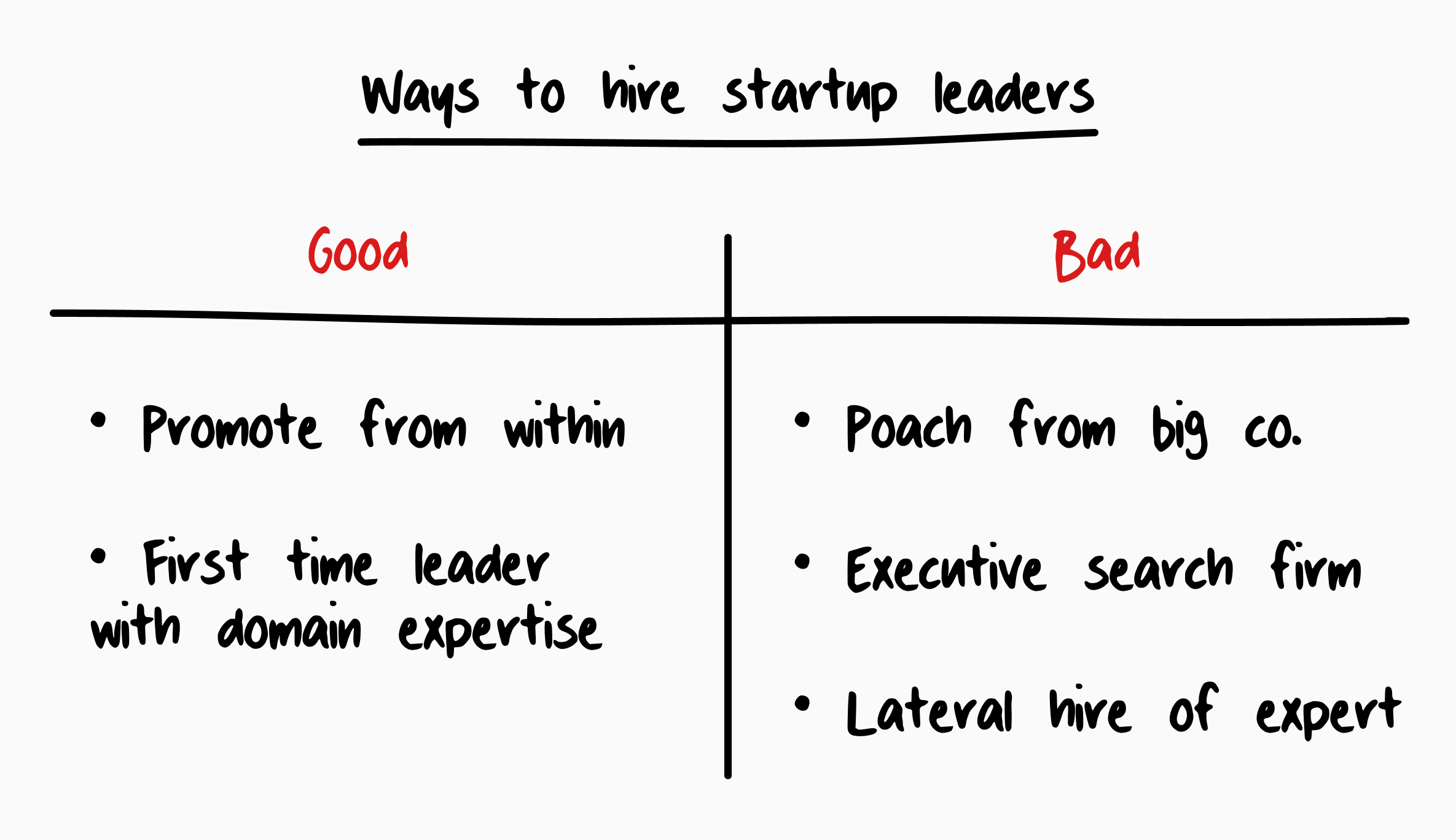
At Albert, after years of expensive trial and error, we have hired all current executives with only two approaches:
- Promote from within
- First time executive with deep prior domain experience
Here's how Albert's current leadership team was hired:
Position | Hiring type | Prior job | Hiring process |
Head of product | Promoted from within | Designer | Hired as first designer at Albert. Promoted to head of product. |
COO | First time exec | Corporate lawyer | Albert's corporate lawyer for 5 years prior to joining as General Counsel. Over a decade of experience as a startup lawyer. Promoted to COO after taking over customer service. |
Head of engineering | Promoted from within | Software engineering manager | Joined Albert as individual contributor. 20 years of experience running small and mid sized teams. Promoted to head of engineering. |
Head of people | First time exec | In-house recruiter | Had built two 100+ engineering teams prior to Albert. Joined Albert as a first time executive, expanding skillset from recruiting to human resources. |
Head of compliance | Promoted from within | Compliance manager | Promoted from within Albert after running compliance for Albert's banking program. |
CFO | First time exec | Investor at large asset manager | Seed investor in Albert. Joined Albert 6 years after investing in Albert. Also worked with Albert's founders for 5 years before Albert was founded. |
Head of operations | First time exec | Operations manager | Responsible for money movement at a large public financial technology company. Joined Albert as a first time executive, expanding skillset to run all of operations. |
Every time we've worked with an executive search firm or hired an "expert" who has done the same role elsewhere, the leaders have failed. It took me years to understand that leaders promoted from within, or given the opportunity to be first time executives with the right tools, are far more effective than their peers.
This approach works because it rewards merit and gives people the opportunity to grow. Ask yourself: if someone was very successful at a job once, why would they move laterally to do the same job again and stay at the new job for a long time?
Importantly, this approach does not scale, because building a leadership team should not scale. It took me nearly a decade to recruit Albert's CFO and COO. There is no shortcut to hiring people who can lead a company for many years.
Sports teams
Championships are rarely won by teams of once all-stars paid above-market salaries.
Sports teams closely resemble companies. The coach acts as CEO. Ownership, like investors and a board of directors, help drive strategic direction. Players, like employees, make the plays on the field—the actual work. The best teams are greater than the sum of their parts.
Sports history is filled with examples of wealthy owners trying to spend fortunes to build a championship team. Team owners hope that a team of once all-stars can reach the pinnacle of their sport together. The owners follow the zero-interest-rate-period hiring playbook. Not surprisingly, this rarely works.
Teams and organizations with the most success follow the opposite approach: they develop talent from within.
The Golden State Warriors developed the best backcourt in the history of basketball; the New England Patriots won six Super Bowls with a sixth round draft pick at quarterback and developed a tight end who redefined the position; the New York Yankees dominated baseball in the late 1990s with a team of homegrown talent anchored around one of the best shortstops in MLB history, drafted and developed by the team. The list goes on.
Slow down, develop
Read the full story
Foundation brings unique insights on business, building product, driving growth, and accelerating your career — from CEOs, founders and insiders.