Read the full story
Foundation brings unique insights on business, building product, driving growth, and accelerating your career — from CEOs, founders and insiders.
Pay More, Hire Less
Great companies can only be built with exceptional people.

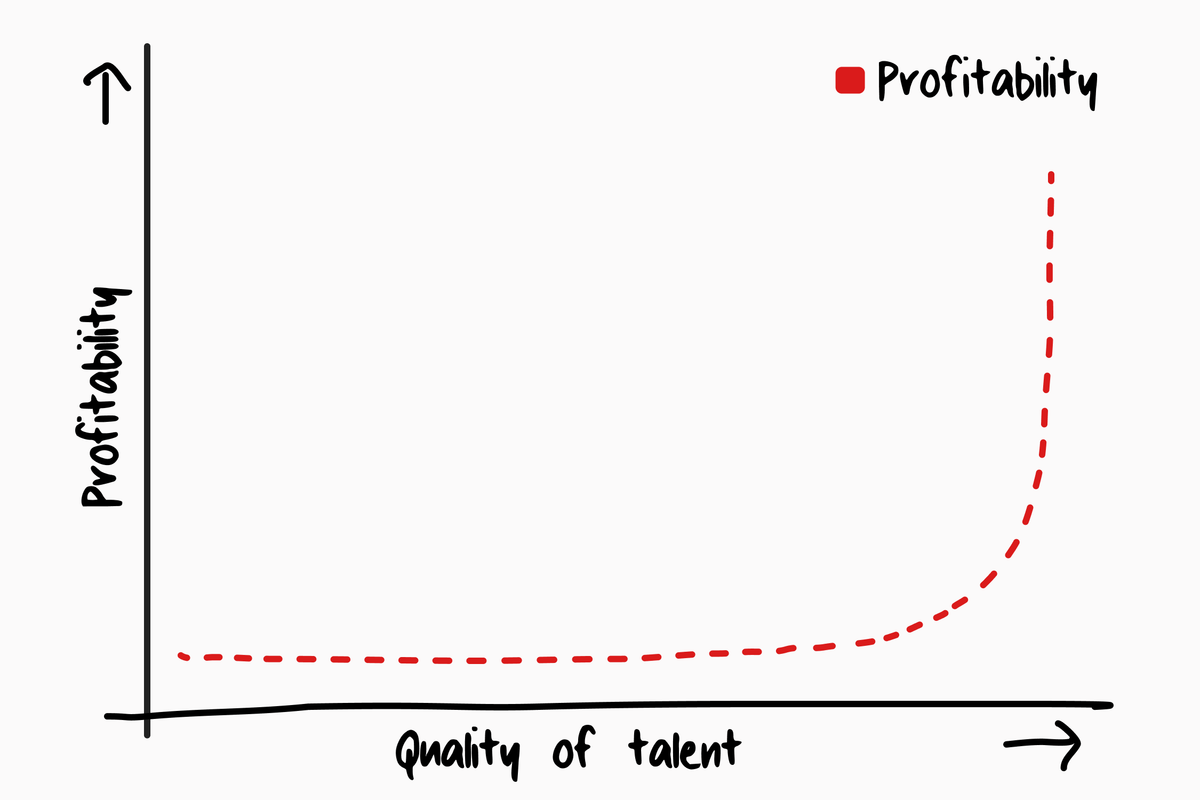
Over hundreds of people I have hired at Albert, the banking app I run, I have found a counterintuitive principle: you save money when you pay people more.
Building a successful company from scratch to scale is, at least statistically, a near impossible feat. It can only be done with exceptional people. Exceptional in their work ethic, their desire for growth through discomfort, and their clarity of thought and purpose. You must hire bright minds who run towards difficult problems.
When you find talented, driven people, you realize that individual performance follows a log scale: an A player does 10x as much as a B player; B player 10x as much as a C player; etc. Hire fewer people, promote great ones very quickly, and pay them very well.
This post is the fourth in a series of posts on how to transform a fast-growing, money-losing company into a profitable one, without sacrificing growth.
Buy cheap, buy twice
Hire carefully, promote quickly, and pay the best very well.
I recently wrote about replacing 5 hours of interviews with a case study, and that interviews are a terrible gauge of likelihood to succeed at a company. The post ruffled feathers on LinkedIn: "no one in their right mind would spend that kind of time for a job offer" or "the solution should not require the interviewee to carry 75% of the commitment." But it's the person surprised by rigorous interviews who demonstrates the effectiveness of the case study.
Because the productivity of an A player is exponentially higher than a B player, hiring B players means that you need ten times as many people to do each task. This leads to a bloated, slow moving, bureaucratic organization.
As you hire more B players, costs grow quickly because you need a lot of them, leading to long-term unprofitability. Worse, mediocre talent builds brittle systems that create ongoing fire drills, inevitably on nights and weekends. This ruins morale.
In contrast, when you hire exceptional people, things get built quickly, systems run smoothly, and morale is high. Total costs go down when you hire the best people and pay them very well.
Revenue per employee at Albert
Paying in the top 5th percentile
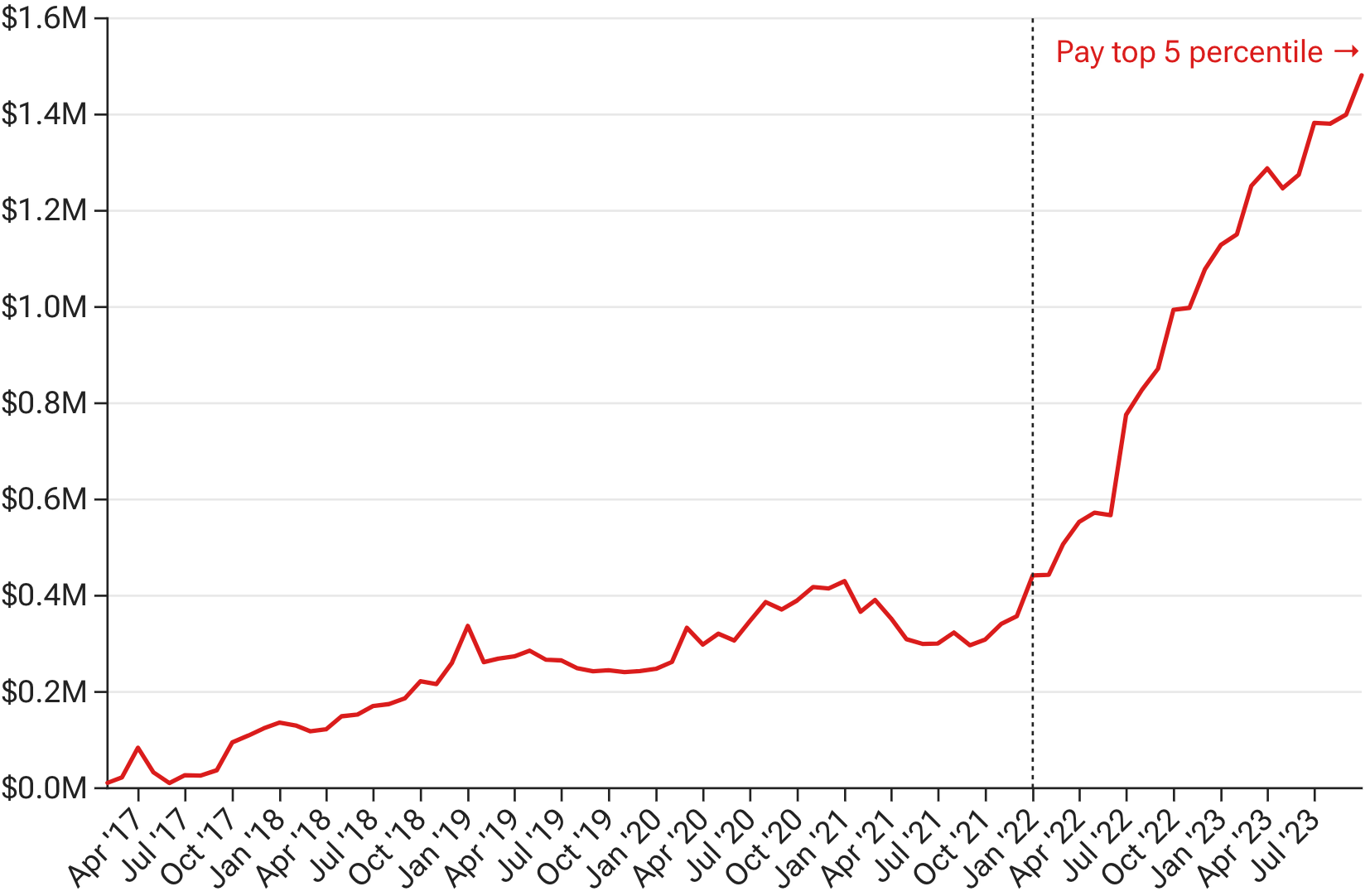
In early 2022, we changed our approach at Albert. We decided to hire fewer people, focus on exceptional hires, and pay in the top 5th percentile of our competitors for leadership positions.
Productivity grew, costs went down, and employee satisfaction jumped. See the chart above: since Albert's change in approach, our ratio of annual revenue to full time employee has grown from $0.4 million to $1.5 million and still growing. This means 65 employees at $100 million of revenue, 130 employees at $200 million of revenue, and so forth. Google and Meta, two of the most profitable companies in the world with enormous scale, also have a ratio of $1.5 million of annual revenue per employee.
To find great people at a startup, follow the principles below, which took me a decade to understand.
- Clear thinkers only. Find people who can explain what they do to a novice. Ask people to "ELI5," shorthand for explain it to me like I'm 5 years old. Never hire someone who says that their domain is too complicated to explain to an outsider.
- No big company people. People who work at big companies are used to having a deep support apparatus, and they're unfamiliar and uncomfortable with how much you have to do on your own at a startup. I've never seen a big company executive succeed at a startup.
- Take your time. Only hire people who you are near-certain will be exceptional. This is difficult for venture capital backed startups with investor pressure to scale, but you must be patient. Missing on a B+ candidate is a good thing. Today, we follow this approach at Albert, even with hundreds of employees. There was a time at Albert—during the zero-interest-rate period—that we loosened our hiring standards, and it cost us dearly: years of productivity lost and millions of dollars wasted.
- Find people who prefer ambiguity. Some people want prescriptive instructions; some like to chart a new path. Project specs change multiple times for all projects at startups. Big company people, who generally like prescriptive instructions, protest changing requirements.
- Challenge + discomfort = growth. Find people who embrace this principle and are willing to challenge themselves beyond comfort.
When I hire an executive, I disclose the compensation package for the job in our first or second conversation. I explain: I did my research and I know this package is above the 95th percentile for this position. There's no need to negotiate because we both know it's top dollar. Now let's see if there's a match!
Can anyone be exceptional?
No one is born exceptional, but anyone can become exceptional.
Hiring exceptional talent is a commitment to hiring on merit alone. No one is born exceptional. Using congenital talent, the greatest athletes, performers, artists and thinkers willed themselves to the top of their fields by working harder than their peers.
Similarly, great performance in the workplace is not driven by which college you went to, your GPA, or your test scores. It's a combination of loving your job, work ethic, and a desire to never stop learning.
Arnold Schwarzenegger recently posted a powerful video in response to rising hate. In it, he explains personal growth: "Easier isn't better. When you spend your life looking for scapegoats, you take away your own responsibility.
Read the full story
Foundation brings unique insights on business, building product, driving growth, and accelerating your career — from CEOs, founders and insiders.