Read the full story
Foundation brings unique insights on business, building product, driving growth, and accelerating your career — from CEOs, founders and insiders.
Meetings Ruin Organizations
Recurring meetings corrode organizations.

I recently heard a story from a friend of someone who won a charity auction for dinner with Warren Buffett. Trying to schedule with Warren, he suggested that his assistant find time that worked for both of them. On the spot, Warren offered dinner the next evening.
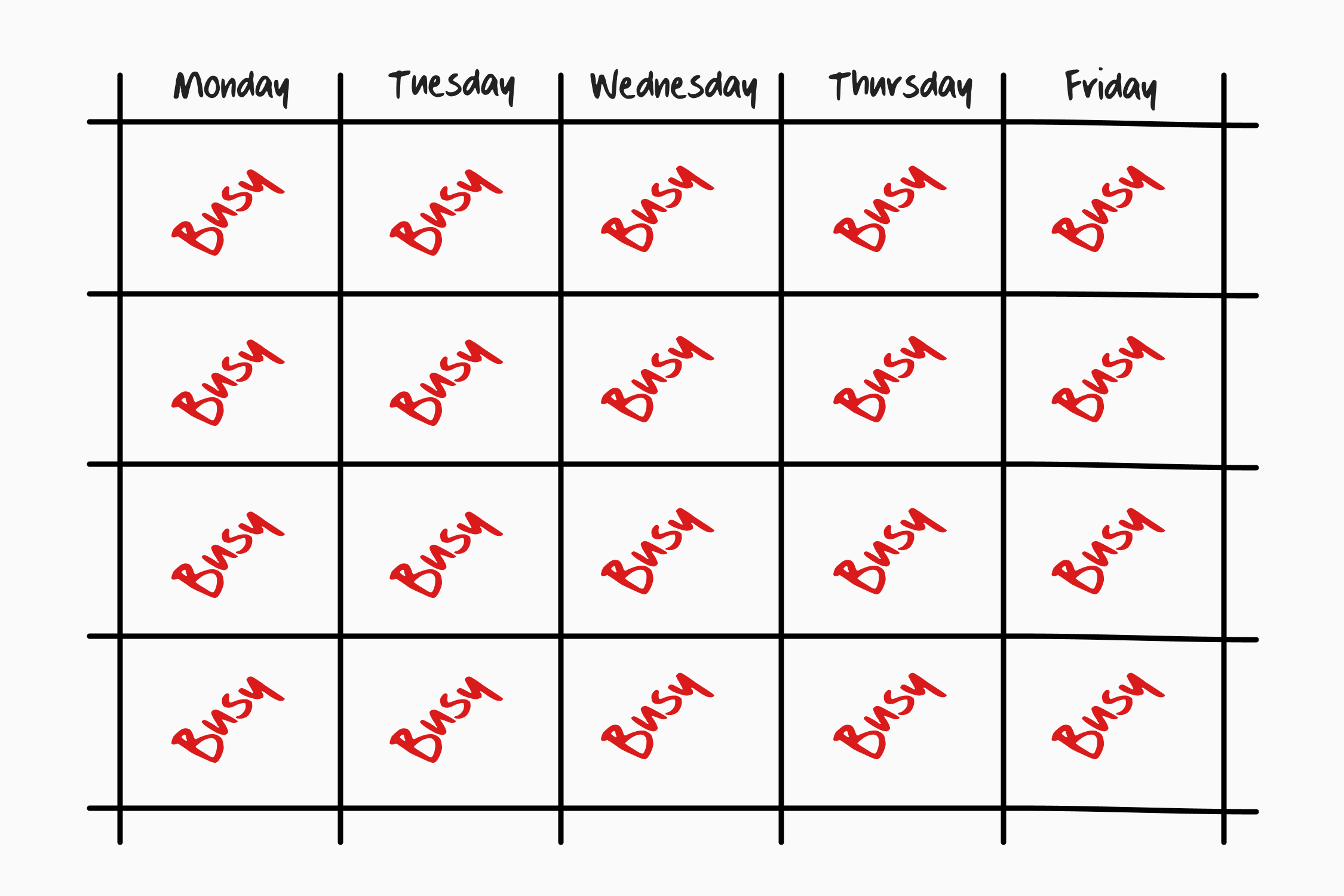
Warren Buffett, famous investor and CEO of one of the most valuable companies in the world, keeps his calendar open. He focuses on work.
In every organization, there are two forces: acceleration and deceleration. One group of people focuses on building; the other slows things down with process. Organizations overrepresented by decelerators stagnate and fail.
One company activity disproportionately drives deceleration: meeting.
Meeting is expensive
Meetings corrode teams. If you work at a company that has a lot of meetings, you've felt it: low morale, running in place, pageantry over progress.
Below are a set of principles for thinking about the impact and cost of meetings:
- Double time to measure true cost. A standalone half hour meeting actually costs a full hour because the meeting will likely start and end late, and you have to switch contexts before and after it.
- Meeting is not working. No work is done during a meeting.
- Schedule matters. Three back to back to back 30 minute meetings cost a fraction of three standalone 30 minute meetings spread throughout the day.
- Recurring meetings are toxic. If you find yourself in more than one or two recurring meetings a week, you must change course. Unless there's an acute issue to solve, let people work.
- Over-meeting drives deceleration. People meeting the most are most likely the ones decelerating an organization.
Do meetings even need to exist? Of course. Teams must coordinate and plan. But much of this work can be done asynchronously and in writing. Meetings are for planning that can only be done live.
A structure that works
Over nearly a decade of building and running Albert, I've developed a schedule that works. Here's my actual calendar:
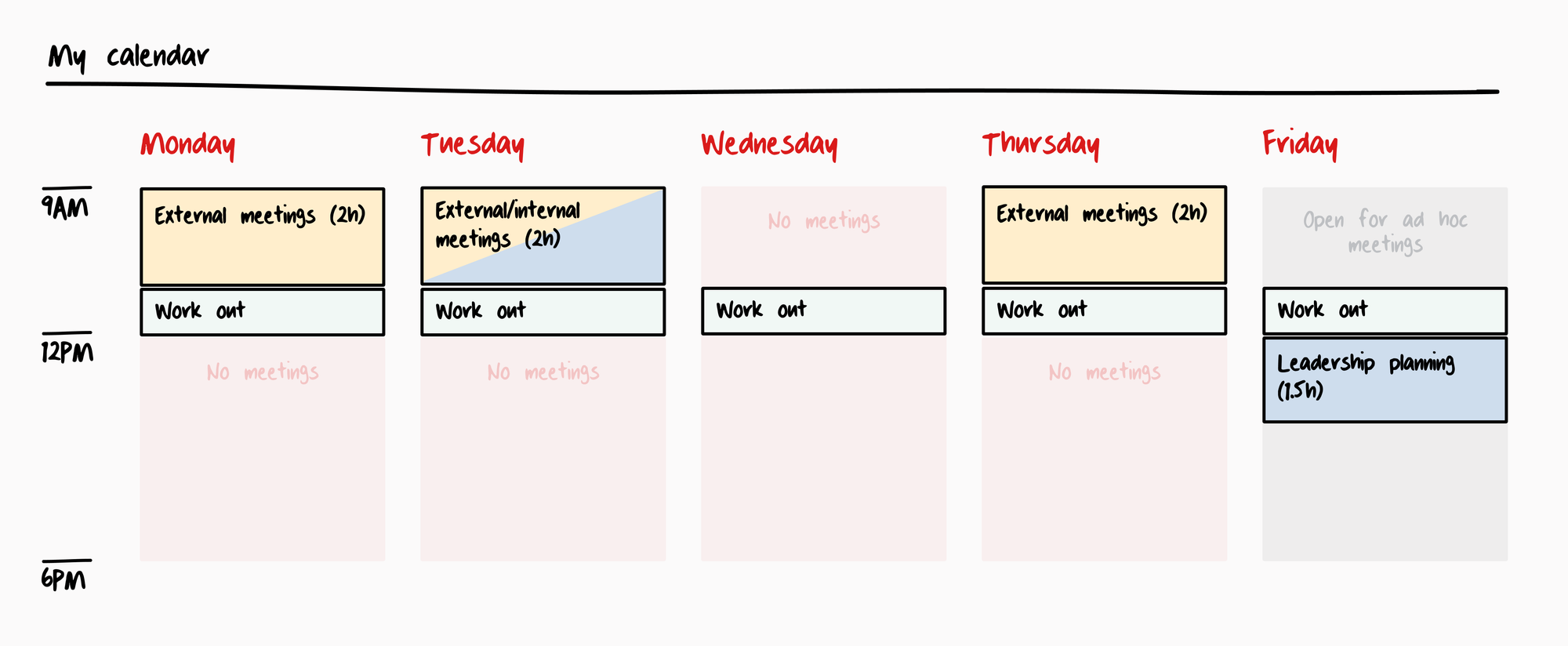
Because meetings are the worst type of workplace interruption, the optimal schedule is one with the fewest meetings possible.
Here's how my schedule works:
- One open day. One full day every week with no scheduled meetings. If you do project based work, this is critical. I find Wednesday effective because it divides the week in halves.
- Half day blocks. Three half day blocks with no meetings.
- Work out daily. Non-negotiable block each day for a workout.
- Meeting blocks. Schedule in blocks to limit context switching.
- Planning day. One day a week dedicated to planning. I have noticed that Friday is much better than Monday for recurring meetings, because Friday is the least impactful day of the workweek.
- Limit external meetings. Focus only on the most important customers, investors, strategic partners, and important prospective employees, and say no to the rest.
If Warren Buffett can keep his schedule open, so can the rest of us.
Do work
Optimize for output.
There is a simple principle to follow when building, managing, and hiring: optimize for working and output.
Use a common sense filter when deciding what to spend time on: does something push you towards your work or away from it? For example, hiring a big company executive to manage people at a small organization pushes you away from work because the executive will want to institute big company process instead of doing detailed work. Excessive design, planning and documentation in lieu of actually building pushes you away from work.
If you optimize for doing your work, you'll maximize your chance of success.
Read the full story
Foundation brings unique insights on business, building product, driving growth, and accelerating your career — from CEOs, founders and insiders.