Read the full story
Foundation brings unique insights on business, building product, driving growth, and accelerating your career — from CEOs, founders and insiders.
Is RIF a Dirty Word? How Necessary Layoffs Are Done Gracefully
The workforce must match the operating scale of the business.

High growth tech companies hire quickly. But firing quickly as a countermeasure is rarely used, and it is avoided for good reason: employees and their families depend on salary and healthcare; company stability is important for worker mental well-being; building quality relationships with coworkers takes years; and more.
Sometimes layoffs are necessary, though. While poorly managed layoffs can derail a company, impacting many more people than those initially laid off, correctly managed layoffs ensure the survival of the company with minimal disruption to impacted employees. Below is a blueprint on how to approach layoffs, known in industry jargon as a reduction in force, or a RIF.
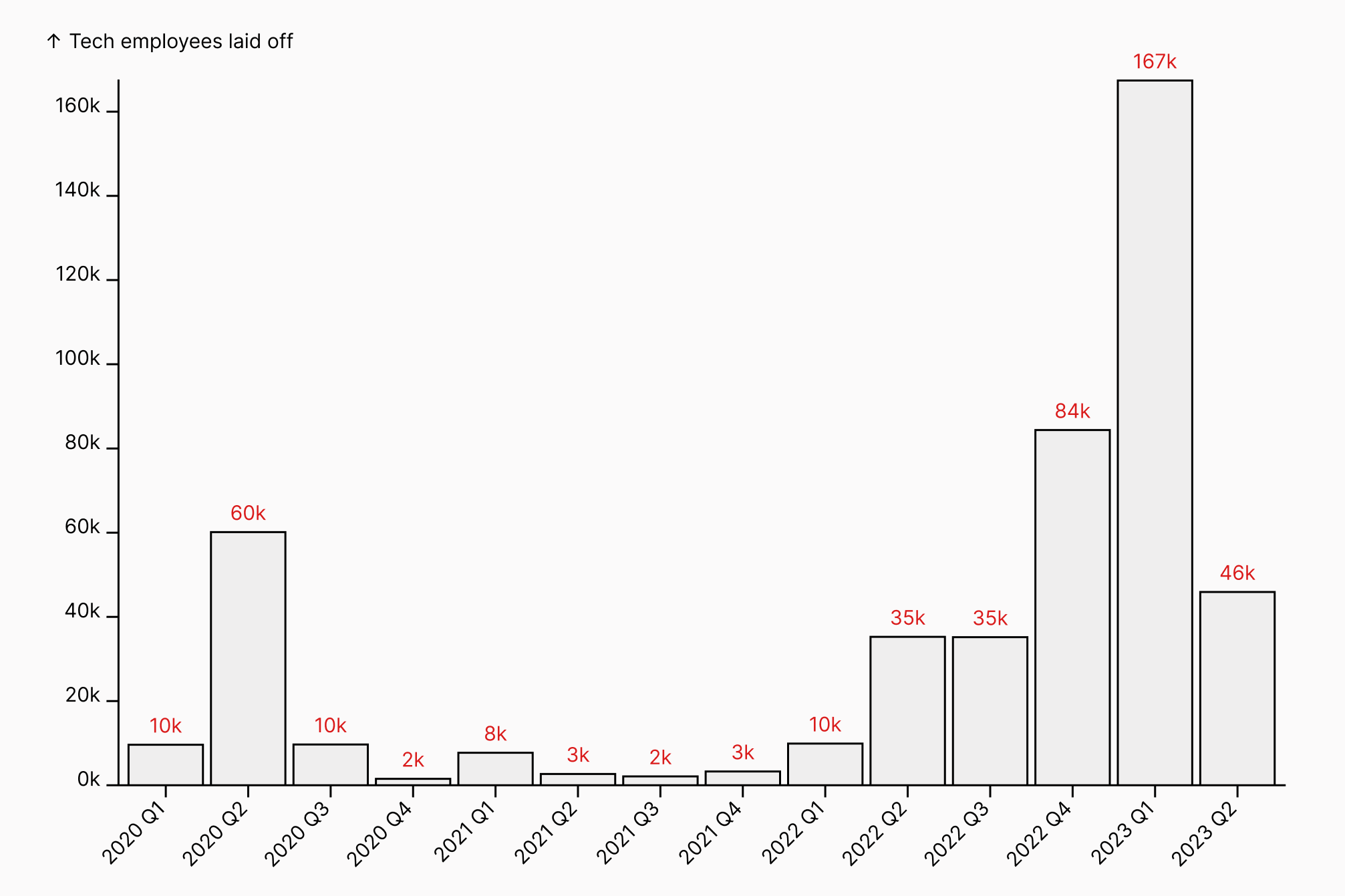
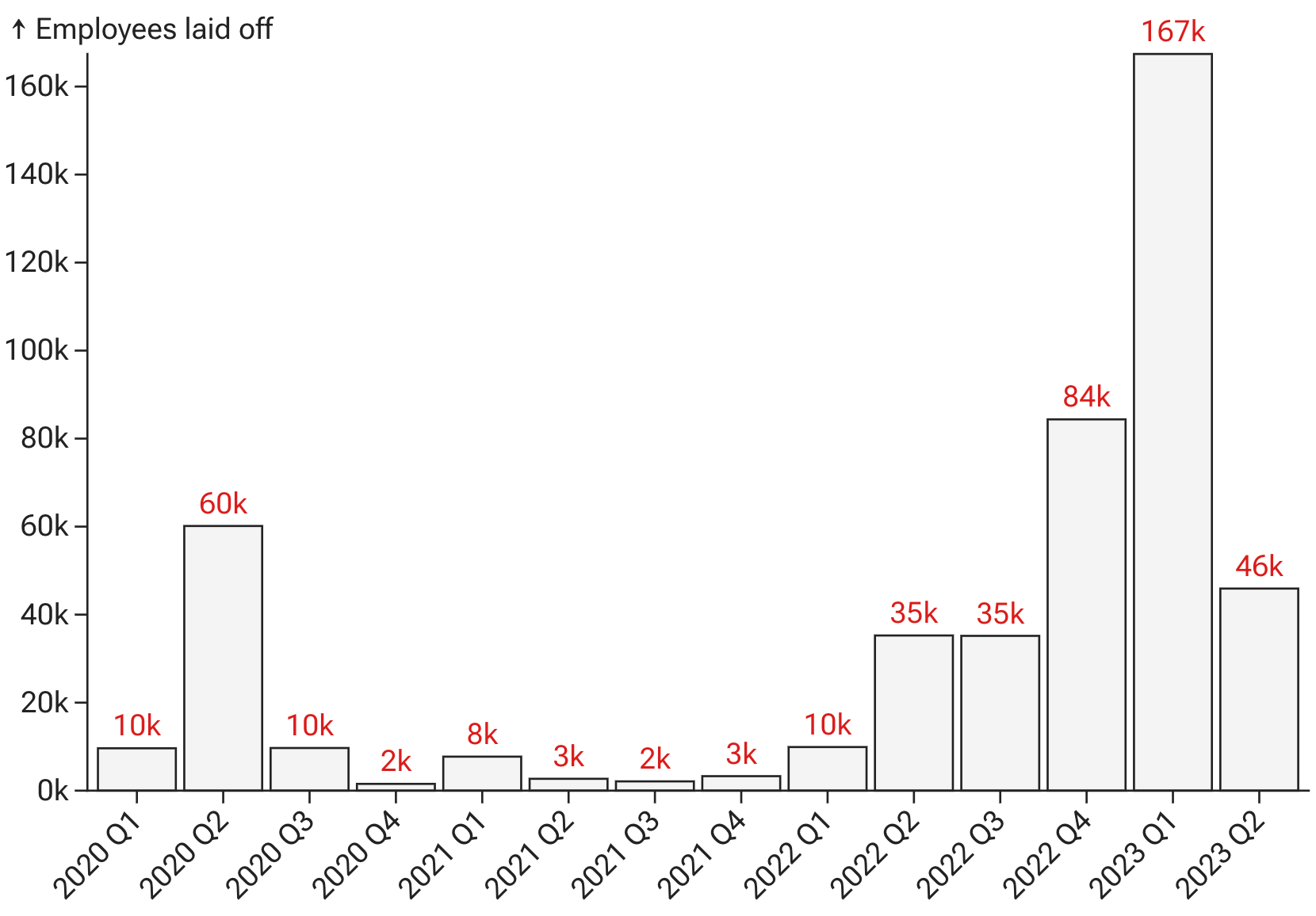
Tech employees laid off since 2020
My story
In June 2022, we realized that the operating metrics of Albert, the banking app I founded in 2016, could not support the size of the company's workforce. We made a common mistake made by other venture capital backed tech companies: we hired to meet future demand. G&A costs as a percentage of revenue reached over 50%, which was too high for a company generating almost $100 million of revenue.
With few exceptions, companies should only hire to meet current demand. While the future growth we projected at Albert ultimately did come, it came later. Companies cannot afford to incur operating losses while waiting for growth, and Albert was no exception. When we did grow into the projections, we hired again.
We learned several important lessons at Albert:
- Act decisively if operating income does not support the size of the workforce.
- A reduction in force can be handled gracefully.
- The negative impact on company culture is overstated when a RIF is handled correctly. While a RIF is initially disruptive, a strong company culture will survive. People will later appreciate that resizing the workforce was necessary for survival.
How to conduct a RIF, correctly
Once you've realized that the company's operating metrics do not support the size of its workforce, you must reduce the size of the company. And you must act swiftly. Delaying the decision spends precious dollars needed to survive until growth catches up.
The basics
- Do it once. You must let go of a sufficient percentage of the workforce to avoid laying off more employees soon after. A simple rule: never lay off less than 20% of the workforce. Either lay off more than 20%, or do not lay off anyone. The RIF will impact many people's lives, so the savings to the company must be worth the trouble.
- It comes from the top. The CEO is responsible for hiring. Therefore, the CEO is also responsible for reducing the workforce and delivering the message to the company.
- Explain why. The CEO must clearly explain that the business doesn't have the cash flow to support the current workforce. This doesn't necessarily mean that the business is in trouble. All it means is that people costs outgrew operating income.
- Help impacted employees. It is the company's duty to minimize the impact on employees being laid off. There are several things a company can do:
(i) Severance: 1-3 months depending on tenure and company's financial position.
(ii) Extend option exercise window: allow employees more time to exercise options, if the company has granted options to employees.
(iii) Help getting a new job: if the company has in-house recruiters, they will have time over the coming months because the company is not hiring. They can help impacted employees find and apply for new jobs.
The day of the RIF
Before layoffs at Albert, I spoke with many HR leaders and CEOs and compiled their experiences. Below is the methodical approach that we used at Albert for the day of the RIF, derived from those conversations. Each step—and the order of each step—is important, as this process minimizes confusion and acrimony, provides transparency, and treats everyone with humanity.
Task | Time | Responsible | Recipient |
Disable access to privileged information | 9:00AM | IT | Impacted employees |
Turn off ability for people to post in popular public Slack channels | 9:05AM | IT | Whole company |
CEO Slack or email to entire company informing everyone of the RIF (see example below) | 9:15AM | CEO | Whole company |
Send a Slack message and personal email to the impacted employees | 9:20AM | Head of people | Impacted employees |
Remove access to all services except Slack | 9:25AM | IT | Impacted employees |
Executives with teams entirely not impacted send messages to their teams that they are not impacted | 9:25AM | Executives | Employees on teams not impacted |
Executives send calendar invite to their impacted team members to discuss practical next steps | 9:30AM | Executives | Impacted employees |
Executives send Slack message to the managers impacted on your team, informing them of who was impacted | 9:35AM | Executives | Managers of impacted employees |
Turn off slack for impacted employees, and re-enable the ability for people to post in popular public channels | 9:45AM | IT | Impacted employees |
1:1 meetings between executives and impacted employees | 9:35-1:50PM | Executives, HR | Impacted employees |
CEO meets with team leaders | 1:00-1:45PM | CEO | Director and above |
CEO all-hands with entire company | 2:00-2:45PM | CEO | Whole company remaining |
Executives send message rallying their teams | 3:00PM | Executives | Whole company |
HR sends out the exit guide emails, including severance Docusign, COBRA information, etc. | 3:00-3:45PM | HR | Impacted employees |
CEO and executives meet with managers | Next day or coming days | CEO, executives | Each team individually |
CEO meets with all people who were on vacation to repeat the all-hands | Coming days | CEO | Employees who were on vacation |
When should a company use a RIF?
Read the full story
Foundation brings unique insights on business, building product, driving growth, and accelerating your career — from CEOs, founders and insiders.