Read the full story
Foundation brings unique insights on business, building product, driving growth, and accelerating your career — from CEOs, founders and insiders.
Conquering Builder Anxiety
Building something new is a string of consecutive sprints. This is painful.

If you've founded a startup or a small business, like tens of millions of Americans, you've felt anxiety at some point on your journey. Probably panic too.
You're not anxious about one specific thing, as you'd rationally think you might be. You have delocalized anxiety. Perhaps you feel nausea, or crawling out of your own skin, or you're surrounded by cacophony. So common are the symptoms that on HBO's Silicon Valley—part parody, part documentary about building a startup—the founder of the fictional startup vomits in front of the whole company right before a presentation.
But he's not crazy. And neither is anyone who has felt this way. Building something new is an epic, body-and-mind consuming challenge that pushes you. Like many things that drive growth, this is painful.
Running hard, all the time
Building a new business is a collection of back to back sprints.
At a startup, something goes wrong every week. You maintain extreme optimism to push forward. Part of a company's success is in its ability to harness paranoia and anxiety to anticipate and avoid all of the things lurking around the corner that could go wrong. Optimism and paranoia are rewarded with euphoria when things go right and punished with bouts of panic when things go sideways or worse.
Building something is similar to running hard. Sprint a mile as hard as you can and you'll feel terrible at the end. Now try a few of those sprints in a row. Building a company is a long collection of back to back one-mile sprints.
Building something from scratch forces your brain to run as hard as possible for a long time. Anxiety is like lactic acid buildup in the brain. Just like your muscles get sore, your mind does too. This is not to minimize anxiety of the builder, but to call it what it is: pain from extreme mental exertion.
To build something great, exertion is required. The question I've long asked myself: must this exertion be accompanied by panic? Fortunately, the answer is no.
A solution
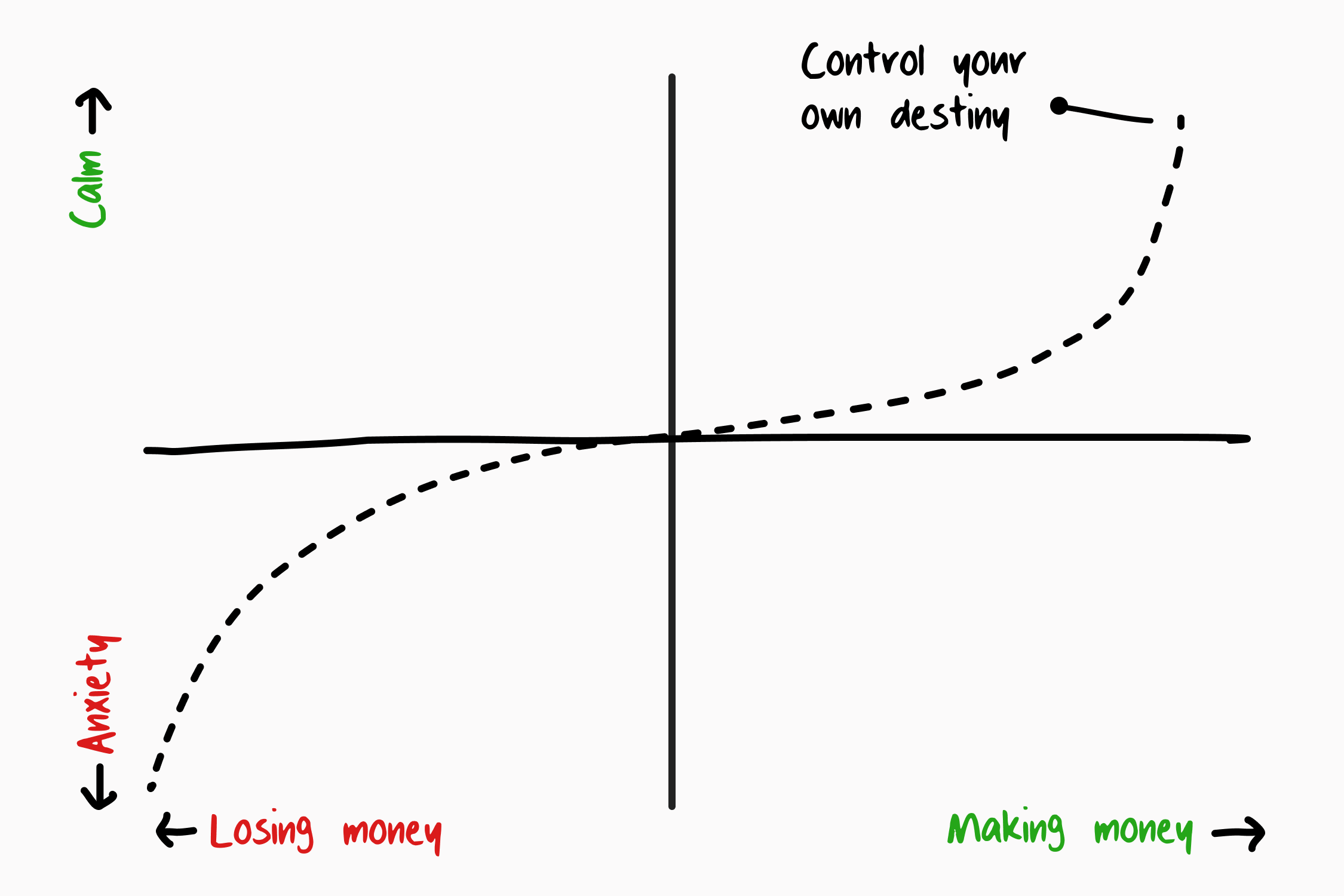
As long as you have the drive to build, you never defeat anxiety. But you can mitigate it to near zero.
It took me many years of building a company to discover two things most effective at minimizing builder's anxiety:
- Training
- Positive cash flow
I know, right?
As long as you have the drive to build, you'll find yourself working very hard. If you run mental sprints, your mind will be sore. Enter training and cash flow.
1. Training
Work out 5 days a week for one hour a day.
Body and mind are inextricably joined. You must train your body to withstand the exertion you put your mind through. How could you possibly work 70 hours a week at full concentration without being in shape? You'll burn out repeatedly, because you lack stamina.
Exercising 2-3 days a week is not enough. I used to believe it was, but I underestimated how much conditioning is required to build a company.
When you start exercising every day, you'll initially feel worse. No one talks about this. It makes sense though: you're out of shape, so you've added another vector of stress. But after a couple of months, you'll notice a big difference. You develop focus because you are better conditioned. Buzzing distractions are easier to block out. A long week goes by and you're fresher on the weekend. You sleep better. You're calmer.
All you have to do is run or bike for 20-30 min and do a bunch of pushups, crunches and jumping jacks. One hour. That's it. As you stick to it, you'll get into it more: Peloton classes, a trainer, group sessions like SoulCycle and Barry's, training for a race, and more.
I wish I had started working out every day a lot earlier in my startup journey.
2. Positive cash flow
Make cash increase every month.
Founders and early employees have one common existential worry: that they won't be able to make ends meet next week, month or year.
When a business is less than 18 months away from running out of money, like most startups, everything is a fire drill. One bad week of growth? Disaster. Lost a big customer? You think you'll never raise money again.
In September 2022, when Albert reached profitability, my relief was overwhelming, which surprised me. Negative cash flow wasn't something I fixated on. I knew that we had to keep raising money or we'd run out of money and fail, but so did most other startups, so I naively thought that this didn't affect me.
When Albert started making money, we entered a new mental state. Fire drills were replaced with methodical plans. Overall company morale improved. Company leadership, who have invested a large part of their life in the company, knew they had jobs even if investors temporarily soured on consumer financial services, which incidentally, they recently have.
In hindsight, I would have focused on driving Albert to profitability many years sooner, if for nothing else than morale.
The other things
There are many other things recommended for general mental well-being. Avoid negative people, sleep eight hours a night, eat sensibly, put your phone away as much as possible, and more. Although hard to stick to, these are basic building blocks to living a happy, healthy life. They are necessary, but not sufficient, for maintaining a healthy mental state while building a company.
A disclaimer
Of course, none of this is medical advice. It's only my experience—that of a founder on a decade-long startup journey. These things worked for me. While training and positive cash flow may not have the same overwhelming impact on everyone that they had on me, I'm confident they'll do everyone's mental state a lot more good than harm.
Why put yourself through all of this?
Read the full story
Foundation brings unique insights on business, building product, driving growth, and accelerating your career — from CEOs, founders and insiders.