Read the full story
Foundation brings unique insights on business, building product, driving growth, and accelerating your career — from CEOs, founders and insiders.
A Better Way to Hire: the Case Study
Candidates need to be sure they like the job; companies need to know that a candidate can do the job.

When companies raise a lot of money, the first thing they do is hire a lot more people. The theory goes that more people do more, so capital—and thus hiring—will drive more growth.
But in practice, this theory is not true. The problem is that individual performance follows a log scale: an A player does 10x as much as a B player; B player 10x as much as a C player; etc. And A players are rare.
It took me hundreds of hires as CEO of Albert, the banking app I founded in 2016, to fundamentally understand this. Only the most exciting, prestigious companies in the world can hire many A players quickly. For everyone else—especially startups finding their footing—hiring A players is rare, and hiring a lot of B players does not translate to productivity growth.
Hire stars
When you work with a star, you know it immediately. If you're not sure, they are not a star.
You'll search for a star—the A player— for a while, think you've found them, but have many false starts. When you do find stars, it will transform your organization. Companies are on a mission to hire as many stars as possible.
Years ago at Albert, we hired a junior frontend engineer who seemed promising. One Friday afternoon he decided that our internal customer support and financial advice application (now used by more than 500 agents and advisors, handling 50,000 messages/day) should have dark mode. Before he left that night, the application had dark mode, with no input from the design or product teams. Dark mode is still heavily used today. A couple of years later, the same engineer converted hundreds of thousands of lines of code from Python 2 to Python 3 in two days. This was an epic feat. Both of these projects would have taken a large organization weeks and dozens of people to complete. Fast invention and iteration is the lifeblood of a growing company, which only stars can drive.
A better way to hire
Interviews are a terrible gauge of likelihood to succeed at a company, while the take-home case study is a great predictor of success.
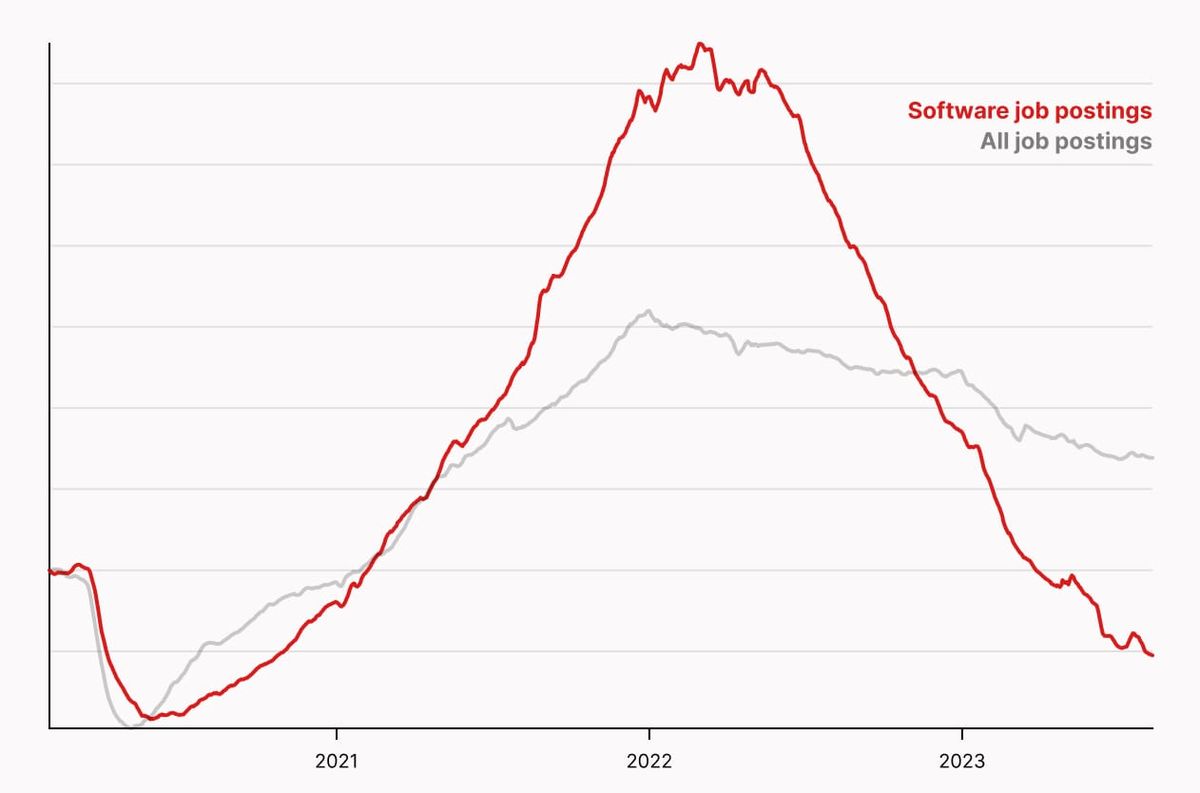
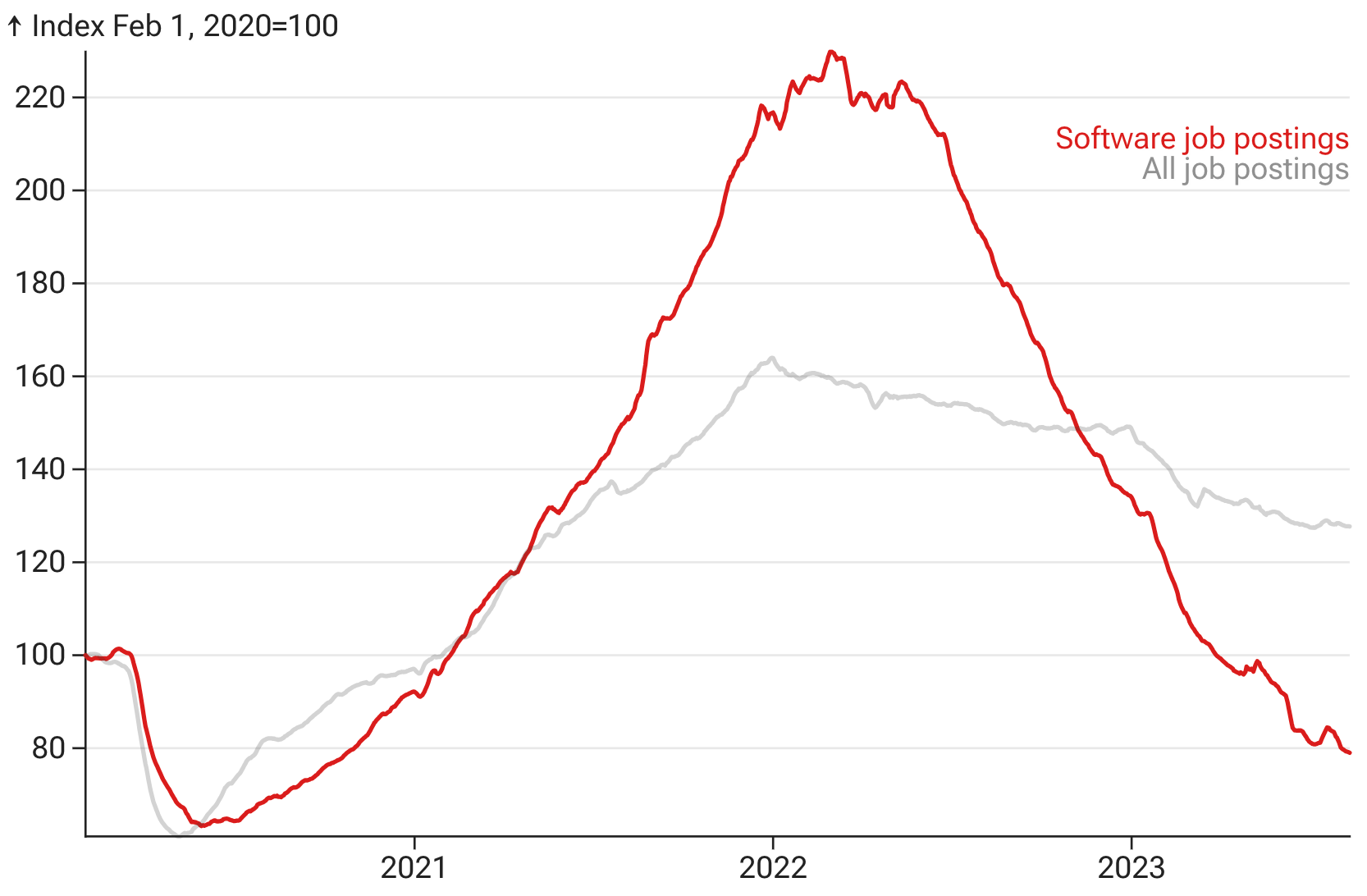
The goal of a great interview process is to find stars. When the Federal Reserve lowered interest rates to zero at the start of the pandemic, the startup hiring market became grossly imbalanced. Money was cheap, companies raised a lot of it and used it to hire quickly. There was an explosion of job openings in multiple sectors. Candidates started getting multiple lucrative job offers within days of starting their job search. It became impossible to get to know a candidate before making an offer.
Software job posts on Indeed
Before 2020, every candidate that interviewed at Albert completed a job specific, take-home case study that took up to four hours to complete. In 2020, candidates began refusing the case study because the interview process at other companies was faster and simpler. We stopped the case study. Not only were we spending less time with candidates, we found that interviews alone are a terrible predictor of a candidate's likelihood to succeed at a company.
In 2023, with the job market normalizing, we have been able to restart the case study. We resurrected our best hiring tool.
The case study
Candidates need to be sure they like the job; companies need to know that a candidate can do the job.
How does a company know if a candidate is good at a job if they don't see the candidate perform the job? How does the candidate decide if they like the job if they don't try the job? Sitting through six hours of interviews with prospective coworkers answers neither side's question.
The solution: a take-home case study for every candidate. Below are examples for three roles.
Case study examples
Position | Case study | Grading notes |
iOS engineer | Build an app that lets a user search a public endpoint of books, display search results, and click on each book for details. Persist search queries for future searches. | • Reasonable frontend framework • Clean code • High quality user experience |
Customer service escalations agent | Candidate receives three scenarios in which a tier 1 agent performed poorly. For each scenario, provide de-escalation responses and explanations of how agents could improve. | • Gets the tone right to de-escalate • Never accuses the customer of wrongdoing • Provides a clear explanation of how to train future agents |
Head of risk | Candidate receives a raw dataset of transactions with examples of anomalous activity in the data. Create an excel dashboard of charts to monitor risk and find the anomalies. | • Dashboard provides a clear way to monitor risk based on the data provided • Identifies the anomalous activity correctly |
Grading a case study is straightforward because there are generally three discrete outcomes: (i) good, (ii) bad, and (iii) candidate declines to do the case study. There is surprisingly little middle ground and the bad is usually obvious: doesn't solve the problem, poor written communication, messy code, etc.
The good is also easy to identify. For example, in a product engineering case study, while candidates don't need to build a production app, they must write sane code and build a high quality user experience, both of which are easy to spot. Years ago, in an Albert iOS case study that asked candidates to build an app that searches a book library and display results, a candidate added a nicely designed empty state when no search results were returned. Coupled with an already strong solution to the problem, this showed great product sense and attention to detail, both valuable in an iOS developer. The candidate joined Albert and contributed fantastic work for many years.
Declines, while not common, are a key to the case study's effectiveness, because they save so much time. Candidates usually decline for two reasons:
- They believe that doing a case study is for someone junior. If you're looking to hire doers, this is an effective filter. Managers should do case studies as well, adapted to the manager's job requirements.
- They claim the company is trying to get free work. The candidate mistakenly believes that a few hundred lines of untested code could be used in a production application at scale, or that example customer service responses drafted in a few hours are original and could be used with real customers.
Declines save both candidate and company at least five hours of interviews, and more profoundly, years of unhappiness together.
Hiring process
The case study reduces live interview time to 2 hours, and it gives the candidate flexibility to interview on their own time.
The case study simplifies the hiring process. Here are the steps:
- Recruiter screen: 15-30 minutes. Prioritize hiring an in-house recruiter if you are hiring more than ten people per year. Otherwise this is done by the candidate's future manager or by a founder.
- Touch point with leadership: explain the interview process and case study, and that the company values doers and saving time. This can be done with a thoughtful email. When hiring someone senior, this can be a good opportunity for someone in leadership to spend 30 minutes live with the candidate to pitch the company.
- Take-home case study: candidate spends up to four hours on a case study. The work is reviewed asynchronously by the candidate's future manager.
- In-person interviews: if the candidate passes the case study, proceed to two live interviews:
- 45 minutes with their future direct manager to discuss design decisions in the case study and review projects at past jobs.
- 30 minutes with someone in leadership (e.g. head of engineering, head of product, etc.) for culture fit.
The candidate spends about the same amount of time interviewing, but most of it is at their convenience. The company spends much less time interviewing per candidate, allowing for a broader funnel in search of stars.
State of the hiring market
Read the full story
Foundation brings unique insights on business, building product, driving growth, and accelerating your career — from CEOs, founders and insiders.